While fish can be grilled on BBQ’s, the oven works well too if you happen to strike a wet day but the festivities must go on. If you’re lucky enough to have an open fire, cooking over hot coals produces a taste sensation, especially if the fish has just been pulled out of the ocean.
The full flavour of the ocean comes alive and not only does the food get better by using everything, you show maximum respect for the fish you catch and the people you entertain. Good times.
Recipe by: Joel Hodgson – Natures Kai Prep Time: 10 minutes Cook Time: 16 minutes Feeds: 2 – 4 (depending on size of fish) Difficulty: 2.5/5 Part of fish: Whole fish
Ingredients:
Whole snapper
Lemon
Onion
Dill
Garlic
Salt and pepper
Parsley
Fish sauce
Olive oil
Soy sauce
Chilli flakes
An arrangement of preferred vegetables
Method:
Scale, gut and gill your snapper and leave uncovered in the fridge for a few hours on paper towels dry out and enhance the umami flavour. Pro tip: Use tongs and a rubber band to keep fish upright for easy stuffing.
Stuff the snapper with lemon, onion, dill, S&P and garlic.
Cut slits into the flesh and rub seasoning into the cuts and over the skin.
In a separate bowl, mix together, lemon juice, lemon rind, parsley, fish sauce, olive oil, chilli flakes and a little soy sauce.
Add the fish to the coals/BBQ. Be aware that you will only be able to flip it once.
After about 8 minutes, carefully lift the fish to see if it has come away from the grate yet. If it has, flip.
Now spread across your wet mix over the top of the fish and cook until the bottom lifts away. Again, roughly 8 minutes.
Matt Watson is a long-time LegaSea, Kai Ika and Free Fish Head ambassador. He loves sharing his philosophies around maximum utilisation. Here’s how Matt likes to enjoy his fish heads:
“I’m a fish head eater, and so are my kids. We love that succulent meat hidden in the head, and it’s not hard to enjoy. So how about you give them a try, you can smoke fish heads, steam or boil them, but a convenient way is to oven roast them. Because instead of taking six snapper to feed your family with the fillets, you could eat the whole fish and you only need to take three – that’s got to be good doesn’t it? So give my recipe below a try and if you really can’t bring yourself to give fish heads a go – give them away. Freefishheads.co.nz”
Recipe by: Matt Watson – The ITM Fishing Show Prep Time: 10 minutes Cook time: 20 minutes Feeds: 1 large fish head per person Part of fish: Head
Ingredients:
Fish Heads
Salt
Black pepper
Olive oil
1x Red Onion
1x Lemon (cut into slices)
Method:
Preheat the oven to 200 deg.
Remove gills from the fish heads but leave wings attached. Remove the scales with a fish scaler, a desert spoon or scallop shell works pretty good. Do this out on the lawn because the scales fly everywhere.
Place the fish heads in a roasting dish.
Rub salt into the skin and around the inside of the heads, coat in black pepper and drizzle a tiny bit of olive oil over the fish head.
Add a few slices of lemon and red onion inside and out.
Cover with foil and bake for 20 mins, or when skin starts to split.
“It’s good to eat now but if you like the crispy skin, tip the juice off, remove the lemon and place it under the grill for a few minutes.
To serve, plonk it on the table and hook into it. In my order of preference, the best bits are the wings, cheeks, eyes, and the top of the head. Bewdy!”
In previous episodes, we’ve discussed various uses of discarded fish parts, from grinding into fish meal to utilizing it as fertilizer, but sometimes there’s a simpler solution: eat it! There’s a lot of food in those fish heads and frames, and some populations consider the heads a delicacy. The Kai Ika project is set up to bring those discarded fish heads and frames to the people that want them. Dallas Abel joined us to talk about their mission of Conservation through Utilization. Kai Ika is an honorable project that everyone should know about!
Abstract: This paper develops a diverse economies account offish ‘waste’ that revalues it as ‘surplus’. We examine ‘Kai Ika’, a community marine conservation experiment in Tamaki Makaurau (Auckland), Aotearoa New Zealand. Kai Ika rescues fish heads, frames and offal that were previously ‘going to waste’ and redistributesthem tofish eaters who would otherwise struggle to access these foods. It involves fishers and community sector and Indigenous actors in an initiative that converts would-be waste into surplus. We examine the case as adiverse economic project that nourishes humans, enhances respect for fish as living beings, and potentially con-serves marine resources in the face of global-to-local fisheries depletion. The research is based on community-gathered fish parts collection data, and virtual and email interview data. We analyse this data to produce anaccount of diverse ‘object values’ and fish-related surpluses that derive from surplus labour and other socio-cultural and environmental surplus. We argue that reframing fish economies in this way encourages new anddiverse economic subjectivities and a more connected, relational and cooperative community economy of fish.
Authors: Emma L. Sharp, Ingrid Petersen, Georgia Mclellan, Alana Cavadino and Nicolas Lewis.
Turning your fish heads, wings and frames into Smoked Fish Pie is a great way to make the treasure go a long way, thus allowing for sharing with family and friends. Whilst this takes quite a bit of work, the end result more than justifies the effort. It is good value, really nourishing and above all, makes four sensational fish pies that look big enough for 5 or 6 people but really only enough for 4 people after the naughty second helpings invariably called for.
The essence of this dish is utilising every last piece of the fish and combining this with any leftover stale bread that we accumulate in the freezer (for the garlicky, buttery crust). The utilisation doesn’t stop after the meat is removed, with the head, bones, skin and any leftovers used to produce the concentrated fish stock which carries the dish.
Recipe by: Janet Macindoe – Passed down to proud son Scott. Prep Time: 60-90 minutes Cook Time: 40 minutes Feeds: 16 – 4 pies (scale up or down accordingly) Difficulty: 4/5 Part of fish: Head, wings and frames.
Ingredients:
Filling:
2kg of smoked fish meat
2kg of potatoes skin on – lightly boiled and roughly mashed- leave some lumps
2kg of kumara skin on – same as potatoes
12 eggs hard boiled
20 large stalks of parsley – finely chopped
1kg frozen peas or mixed veges (if in doubt, use more).
The brew:
300g of butter
300g of flour
1L of high octane smoked fish stock
4 onions
A handful of finely chopped parsley.
Garlic bread crumb topping:
2 – 3 bread bags of old stale bread and crusts
2 bulbs of garlic, peeled and crushed
400g of butter
Heaps of ground black pepper
Zest of 4 large lemons.
Method:
The filling:
After a good smoke of your heads, wings and frames (we use a 1:1 ratio of salt to sugar and smoke low and slow), strip the meat, avoiding scales like the plague. Have a bowl of water to constantly rinse your hands. Then go hunting those cheeks, lips and tasty morsels around the back of the head and out of the wings/collars.
All backbones, skins and skulls go in a pot for a good, hard boil up to produce the stock. You will need about 4 or 5 kgs of fish and add about 1L of water. The heads and frames will give plenty of volume (freeze any leftover stock). 45 minutes will do.
While the stock is on the boil, throw another pot on the stove and cook the flour into the butter to make the roux. Take your time, up to 10 to 15 minutes until you can ‘smell the biscuit’. Be careful not to let it get too dark or burnt. Then add the stock using a whisk to ensure no lumps. If too thick, add some more stock or milk. Be careful not to make it too runny. Add roughly chopped onions and a handful of chopped parsley and soften for a few minutes.
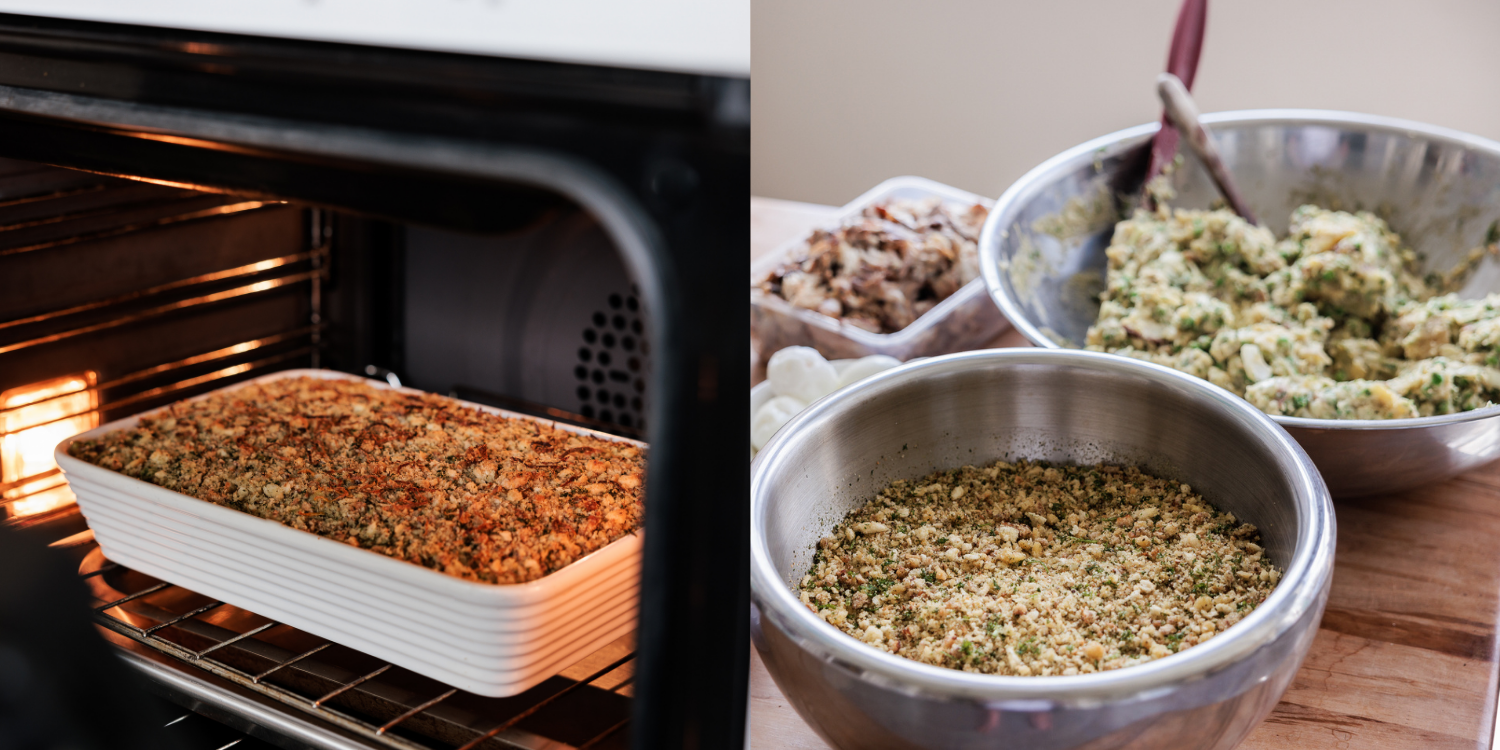
Using a food processor, blitz the bread into crumbs. Don’t be afraid if it is not all the same size this will add to the character of the pie. You’ll need around two large handfuls per pie. Put in a large bowl, mix in the rest of the parsley and pepper.
In a pot on a low heat, combine the crushed garlic and butter, stirring as it melts. Once the mixture is ready, pour it into the breadcrumbs and mix evenly.
The assembly:
Once all the ingredients for the dish are prepared it is time to combine. Use the biggest bowl or pot in the house. Mix the frozen peas, potatoes, kumara, ‘the brew’, and fish meat. Be gentle. Try to retain the pieces of fish – think texture and personality.
Butter the dishes well. Slice a few eggs for each pie and lay them on the bottom. Several handfuls of filling in each dish and then a nice generous topping of the bread crumb brew. Finish off with lemon zest and black pepper. Wrap in aluminium foil and into the fridge. Only gets better with a day or two rest.
Cooking:
Remove foil and into the oven at 160o for 30 minutes and then 10 minutes at 185o. The goal is a golden crust, be careful not to overcook the topping.
Serve with a slice or two of lemon. Most people we know want more.
For the people of the Pacific, seafood has always been a major part of our diets and seas are ingrained in our psyche. —- It’s why Kai Ika’s motto is He Kai te Rongoa he Rongoa te kai, ‘Food is medicine and medicine is food’, in part of their effort to try to re-educate people to re-examine the way they eat fish by choosing parts that they may have originally considered as waste. And there is a shift occurring globally that is helping to re-orientate people’s minds too.
Fish frames are often referred to as ‘waste’. Removing as much of the fillet as possible is the goal for many and whatever’s left over is a mere afterthought. They are a treasure lost as they get tossed overboard or end up dumped or in your trash at home.
Although fish frames are predominantly used to create fish stocks and broths, they can also be used in a number of delicious and exciting ways. Smoking, baking and boiling are some of the common ways to enjoy your frames.
We believe fresh is always best. If you’re lucky enough to have a few fresh frames available, give this super simple but delicious recipe a try!
Recipe by: Tim Nightingale – x_kilometres Prep Time: 20 minutes Feeds: 4-5 as snacks Difficulty: 1/5 Part of fish: Frame
Ingredients:
3-4 large fish frames
Fresh horseradish to taste
100g sour cream
20g diced shallot
15g olive oil
10g lemon juice
20g sliced chives
Small bunch of fennel fronds
Cracked pepper
Pinch of salt
Flatbread or toasted sourdough
Method:
Take your fresh frames out of the fridge (cold fish works best).
Grab a teaspoon and start scraping from the spine down. You’ll lift off all that hard to get to meat and this becomes your tartare. Save the spent frames, they are now ideal for making a clear broth.
Mix your horseradish and sour cream together and smear across a platter.
Put your fish, diced shallot, olive oil, lemon juice, sliced chives and a pinch of salt in a bowl. Give it a quick mix and arrange on top of the horseradish mix.
Finish with a bit more olive oil, fennel fronds and cracked pepper; serve it with some toasted sourdough or flatbreads.
Variations of this dish are completely up to you – sub out horse radish for wasabi, garnish with toasted sesame or drop the sour cream and put your tartare on some whipped avocado. The idea is the fat content from the cream/avocado will carry the flavour of the fish so it’s important to keep it simple.
Just like all marine ecosystems rely on a productive seafloor, many recipes rely on a flavourful base stock. This high-octane fish stock can be used as a platform to create a variety of delicious dishes.
Recipe by: Dallas Abel – Kai Ika Project Coordinator Serves: 2L of stock Difficulty: 1/5 Prep time: 20 min Cook time: 2 hours Part of fish: All fish offcuts.
Ingredients:
2kg of fish heads, wings, frames, skin and pin bones
2 brown onions, quartered
3 Bay leaves
A handful of parsley
1 bunch of thyme
1 tsp of peppercorns (If you have them – colour doesn’t matter)
1L of water
Add the following if you have them laying around:
Couple stalks of celery
A few carrots
1 leek
1 lemon
Place your washed fish parts in a large pot with all other ingredients and water. It’s important not to ‘drown’ the boil up with too much water.
Place the pot on a medium to high heat and bring to the boil. Once it starts boiling, turn the heat down to a medium to low heat.
Gently let the contents simmer for 30 minutes. Some people prefer not to disturb the fish bones. We don’t agree! With a wooden spoon, potato masher or another weapon of your choosing, bash the contents of the pot, paying particular attention to the fish. This releases the flavour and protein from the skin, bones and tissue, giving your stock a full-bodied depth of flavour.
Give your stock another 1 hour on the stove. Once you have removed it from the heat, let it sit for ten minutes before straining.
Allow the stock to cool before transferring to the fridge or freezing.
Note
• The stock will keep for at least a week in the fridge but it’s best to freeze it if not used immediately.
A fish filleting container created by Royal Wolf for a local Auckland marae is now the centre of a research and development project producing organic fertiliser made from fish gills and offal.
Located at Papatūānuku Kōkiri Marae in Mangere, the modified 20-foot container is used by The Kai Ika Project which provide tasty fish heads and off cuts, that would normally go to waste, to the local community.
As well as continuing to help feed families and those in need, the container is a hub for the fertiliser project which is a key part of Kai Ika’s waste utilisation Kaupapa (focus).
“We want to encourage the use of the whole fish. We hope to empower home chefs to prepare less familiar secondary cuts and demonstrate a variety of recipes to cater for a range of skill levels.”